Murrow Legacy Archive
Lorem ipsum dolor sit amet, consectetur adipiscing elit, sed do eiusmod tempor incididunt ut labore et dolore magna aliqua. Ut enim ad minim veniam, quis nostrud exercitation ullamco laboris nisi ut aliquip ex ea commodo consequat.
Artifacts
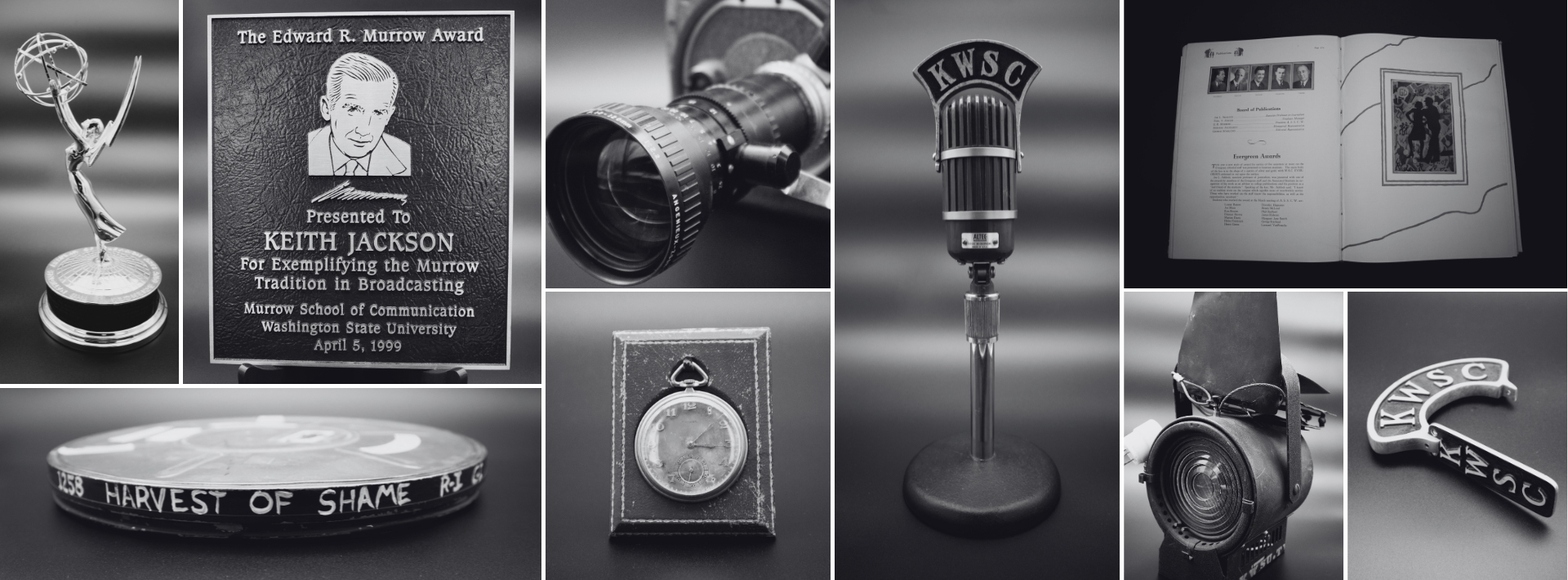
Murrow’s Watch
This pocket watch originally belonged to Edward Klauber, CBS Vice President and Edward R. Murrow’s first mentor.
Klauber appointed Murrow as Director of Talks in 1935 and later promoted him to European Bureau Chief in 1937, a role that enabled Murrow to assemble the legendary “Murrow Boys” team. The watch stands as a powerful symbol of Klauber’s pivotal role in launching Murrow’s historic career.
After Murrow’s passing, his widow Janet H. B. Murrow entrusted the watch to their grandnephew Joshua Murrow Nelson in 1982. In 2013, Nelson donated it to the Edward R. Murrow College of Communication, where it remains a prized artifact on display in Goertzen Hall, connecting the College to its remarkable legacy.
1930 Chinook Yearbook Entry
Murrow’s Chinook record captures him as an active member of a famed fraternity and the campus theater at Washington State College, where he graduated in 1930 with a degree in Speech. The senior yearbook highlights Murrow’s extensive extracurricular involvement, including membership in Kappa Sigma fraternity (one of the largest in the world) and the National Collegiate Players Dramatic Honorary. He served as president of the Associated Students of the State College of Washington, president of the National Student Federation of America (NSFA), and president of the Pacific Student Presidents’ Association—the first student from WSC to hold that position. Murrow was also part of the honorary military society Scabbard and Blade, served as class president, participated in dramatics, and rose to cadet colonel in the R.O.T.C.
The yearbook shows Murrow in the lead role of the play Salamagundi, alongside other distinctions. His presidency with the NSFA later proved instrumental in securing his first position with CBS. These early forays into leadership and performance foreshadowed the eloquent and influential broadcaster he would become.
KWSC Microphone
Before Edward R. Murrow became a television icon, his roots were firmly planted in radio. Richard C. Hottelet, the last surviving member of the legendary “Murrow Boys,” reflected on Murrow’s passion for the medium: “He was highly talented on TV, but his heart was in radio.” – 2008 Murrow Communicator.
That passion began at Washington State College’s first campus radio station, KWSC, founded in 1922. Its earliest microphone was an improvised device—an old telephone mouthpiece mounted inside a soup can. From these humble beginnings, KWSC gave Murrow his first experience behind the mic, shaping the skills he would later use to deliver his iconic wartime broadcasts from London during World War II.
Early Camcorder and Don Hewitt’s Emmy
This artifact traces the evolution from radio to television. Murrow didn’t just broadcast news — he pioneered the form, producing See It Now (coproduced by Fred W. Friendly and host Edward R. Murrow), and insisting that journalistic integrity must remain core, even as technology advances.
Don Hewitt, who worked with Murrow and produced See It Now, later created 60 Minutes in 1968. His eight Emmy wins, Founders Emmy, Lifetime Achievement Emmy, and other honors echo Murrow’s legacy in impactful, narrative journalism. Don Hewitt gifted his Emmys to Murrow College, one of which you can see here, reflecting his true admiration of Murrow, stating “I would give up all my Emmys… I’d swap them all for this one award. They can take ‘em all away, and I’d keep this one.” He directed and produced the first televised presidential candidate debates with John F. Kennedy and Richard Nixon in 1960, one of his many contributions and topics addressed during his acceptance of the 2008 Edward R. Murrow Award for Lifetime Achievement in Broadcast Journalism.
The Murrow Communicator
Distributed during Symposiums nearly every year from 1983 to 2008, this newsletter captured panel insights and student reflections, extending Murrow’s ethos of informed discourse. The Murrow Communicator started as a newspaper and evolved to a magazine format style in 1988. This year’s symposium is revitalizing this tradition for the 50th Murrow Symposium Anniversary. Here you can see the evolution of the Murrow Communicator cover pages and its role in the Murrow Symposium during Keith Jackson’s involvement.
Records Through Time
All of these formats – record, tape, and CD – used to record Murrow and the Murrow Symposium through time demonstrate the evolution of media-capturing technology’s evolution.
Initiated when the Murrow Communications Center opened, the Symposium began in 1973. These tapes archive decades of vital conversations with luminaries like Charles Kuralt, Diane Sawyer, Howard K. Smith, and others, reflecting Murrow’s enduring influence on journalistic dialogue.
The earliest symposium recordings are just audio, followed by tape, CD, and then the digital medium of today. Vinyl would have also been used during Murrow’s lifetime, evidenced by the collection of “I can hear it now…” by Murrow and Fred W. Friendly.
Portrait in Jackson Hall
Murrow’s portrait in Jackson Hall serves as an enduring reminder of his principles: truthfulness, credibility, and courage in journalism—especially poignant for students walking past on their way to class. Painted by Spokane husband and wife artists, Mr. and Mrs. L. Wayne Curtis and was unveiled in 1967 – the Pullman Herald, Thurs., May 18, 1967. It’s a longstanding tradition to leave a cigarette on Murrow’s portrait frame for his “ghost.” However, as a tobacco-free campus, we’re encouraging Murrow’s ghost to kick the habit and embrace a smoke-free legacy.